

I have been recently working on refactoring our Ceph container images.
We used to have two separate images for daemon and demo.
Recently, for Luminous, I decided to merge the demo container into daemon.
It makes everything easier, code is in a single place, we only have a single image to test with the CI and users have a single image to play with.
As reminder, this is what the container can do for you:
- Bootstrap a single Ceph monitor
- Bootstrap a single Ceph OSD with Bluestore (running on a filesystem)
- Bootstrap a single MDS server
- Bootstrap a RGW instance with optionally a user and the ability to interact with
s3cmd. - Bootstrap a rbd-mirror daemon
- Bootstrap a ceph-mgr daemon with its dashboard
This is how to run it:
docker run -d \
--name demo \
-e MON_IP=0.0.0.0 \
-e CEPH_PUBLIC_NETWORK=0.0.0.0/0 \
--net=host \
-v /var/lib/ceph:/var/lib/ceph \
-v /etc/ceph:/etc/ceph \
-e CEPH_DEMO_UID=qqq \
-e CEPH_DEMO_ACCESS_KEY=qqq \
-e CEPH_DEMO_SECRET_KEY=qqq \
-e CEPH_DEMO_BUCKET=qqq \
ceph/daemon \
demo
Obviously adapt both MON_IP and CEPH_PUBLIC_NETWORK with your host specificity.
It’s handy to bindmount both /var/lib/ceph and /etc/ceph so the container can survive a restart.
Output example on my test system:
$ sudo ceph -s
  cluster:
    id:     940848cd-658a-46d1-8161-4bcd37c36ce9
    health: HEALTH_OK

  services:
    mon: 1 daemons, quorum leseb-tarox
    mgr: leseb-tarox(active)
    mds: 1/1/1 up {0=0=up:active}
    osd: 1 osds: 1 up, 1 in

  data:
    pools:   8 pools, 120 pgs
    objects: 216 objects, 5030 bytes
    usage:   1091 MB used, 9212 MB / 10303 MB avail
    pgs:     120 active+clean
Obviously, this container enables the new dashboard manager:
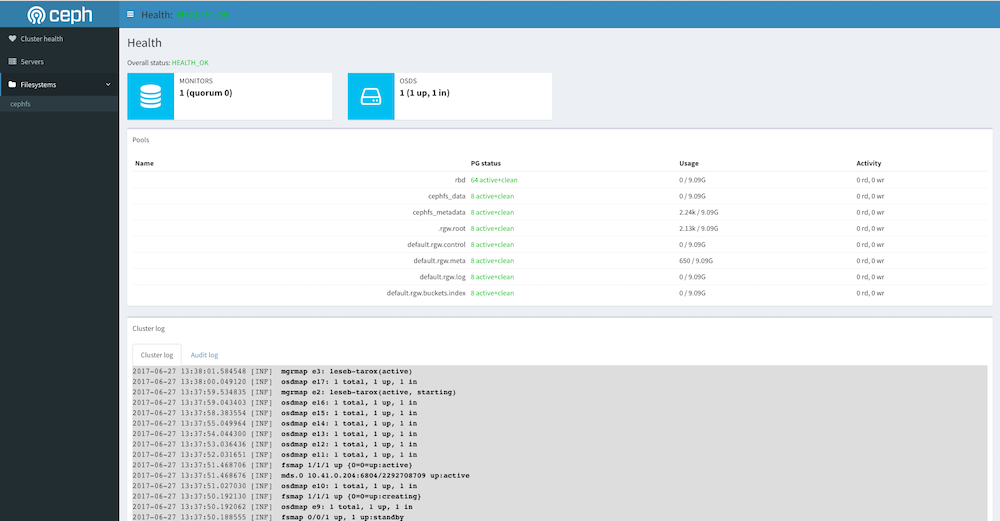
Enjoy this nice preview on Luminous, the current image from the Docker Hub is build on the first Luminous RC.